Claude AI Text Watermarking: Is Human-Written Content Now the Safer Choice?
A Claude response may look completely normal to a reader. But underneath the words, there can be patterns that help indicate whether the text came from AI.
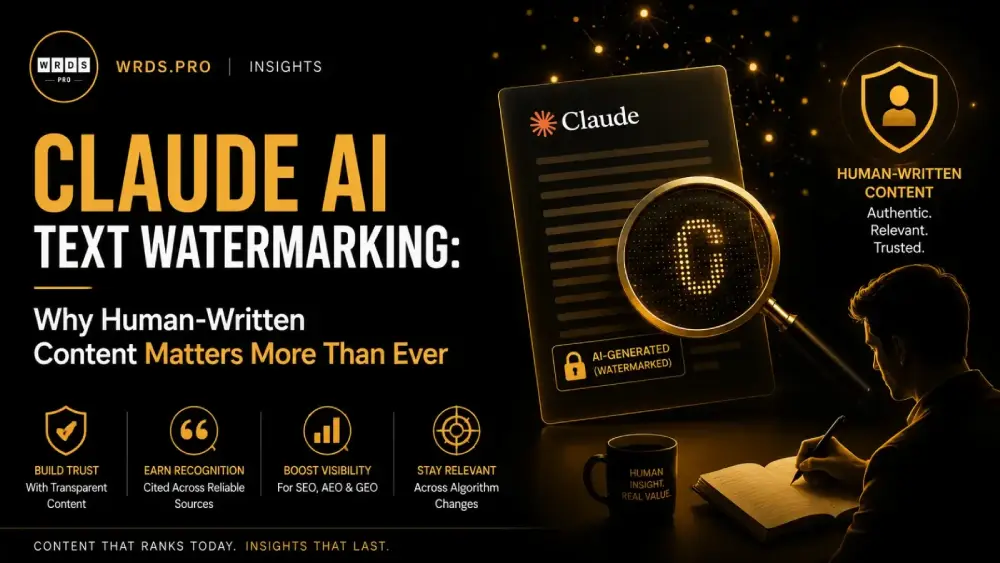
This is where Claude AI text watermarking enters the conversation. Anthropic has been working on ways to make AI output identifiable without putting an obvious label on every paragraph. For businesses, the timing is interesting. Teams already spend hours revising content because an AI detector flags it, only to find that the detector, the model, or the rules change again.
Detection tools evolve, AI models change, and today’s “human” score may hold very little significance tomorrow. As technology evolves, content written to beat today’s detection systems may become outdated. Original, human-led content offers a more practical approach that remains credible despite changing algorithms.
What Exactly Is Claude AI Text Watermarking?
Claude AI text watermarking refers to a method of embedding subtle, machine-detectable patterns into AI-generated text so its origin may be identified without changing how the content appears to a reader.
In its announcement article, Anthropic explained that watermarking works by using small, low-impact choices that appear repeatedly throughout AI-generated text. Together, those choices create a pattern in Claude’s responses. Readers cannot see the pattern, but someone with the right key can detect it. The choices are still made randomly, but the randomness is generated in a different way when watermarking is applied.
What Makes an AI Watermark Invisible?
When a language model writes, it repeatedly chooses between possible words and phrases. AI text watermarking can influence those choices, leading to a statistical pattern across the output. The content can still read completely naturally. The difference is in the hidden patterns within how the words are sequenced.
Why Anthropic’s Approach Changes the AI Content Debate
Until recently, most conversations about AI-written content focused on some key questions:
- Does the introduction sound robotic?
- Are there too many predictable transitions?
- Did an AI content detector flag the content piece?
Claude AI watermarking raises another question: can the origin of the content be identified? A company may publish a useful article today and leave it online for years. During that time, AI models will change, detection tools will improve, and new transparency rules may appear. A piece of content that passes one detector now may be judged very differently later.
Why Has AI Watermarking Appeared Now?
The EU AI Act has pushed transparency around AI-generated material further into the spotlight. For publishers and brands, however, regulation is only part of the story. The change has been implemented from August 2, 2026 onwards.
For businesses, the more practical question is simple: what are we comfortable publishing under our own name?
A business website is not a temporary document. It becomes a lasting reflection of what the company knows, stands for, and asks customers to trust. That makes two things more important than ever: the quality of the content and the source of the content.
What Happens to Today’s Content When Algorithms Change
A page that stays online for several years may encounter:
- Different search ranking systems
- Better AI content detection
- New publishing requirements
- Changing AI models
- Completely different expectations from readers
Nobody can future-proof a page against every technical development. Trying to predict every detector is probably the wrong job anyway. The better approach is to create content that stays useful and credible, even as the tools used to judge it keep changing.
AI Detection and AI Watermarking Aren’t the Same Thing
It is easy to mix up AI detection with AI watermarking, but they work in very different ways. An AI detector generally looks at the finished writing and makes a probability-based judgement about its origin. A watermark is built into the text while Claude is generating it, through subtle patterns in the word choices it makes.
So, “Copyleaks says human” and “there is definitely no watermark” are not equivalent statements. The opposite is true as well. If a detector flags a paragraph, that alone does not prove it has found an AI text watermark.
Does Rewriting an AI Draft Make It Human?
Editing is useful, but it should not be confused with authorship. Minor edits can change how AI-written text sounds, but they do not add real experience, original thinking, or first-hand insight.
A human writer can call the client. Ask why customers choose them. Challenge an inaccurate brief. Notice that everyone in the industry keeps repeating the same claim without explaining it. Those decisions happen before the first word is written.
What Human-Written Content Brings to SEO and GEO
Human-written content carries the details AI cannot invent from probability alone.
A writer can bring in:
- Something a customer actually said
- An example from the company’s own work
- A founder’s opinion
- Regional search habits
- An awkward but useful question
- A detail competitors have completely missed
Research-driven, authentic, human-written content improves SEO and GEO by adding real value beyond keyword placement.
FAQs
No visible mark necessarily appears on the page. The idea behind Claude AI text watermarking is machine-readable identification rather than placing an obvious watermark over the words.
No. AI detection tries to judge whether a piece of text was likely written by AI. Watermarking is a separate method intended to leave a detectable signal during generation.
Yes, it can be, particularly when writers contribute original examples, clear answers, and genuine business knowledge. GEO needs content that gives clear answers, relevant details, and enough topic-specific information for both readers and generative search systems to understand it accurately.
Not necessarily. Basic edits may change the wording, but they do not guarantee that any underlying watermark or detectable pattern has disappeared. The exact behaviour depends on how the watermarking system works and how much the text has been changed.
Final Thoughts
Algorithms have changed before, and they will change again. Claude AI text watermarking simply gives businesses another reason to think beyond today’s AI score. wrds.pro does exactly that. Our human writers start with the business, not the detector. We research the brand, understand its audience, and write original SEO, AEO, and GEO-optimized content designed to stay useful even as detection tools continue to change.
With wrds.pro, the focus stays on genuinely human content that remains worth publishing long after the next algorithm arrives.