What Is GEO? Why Founders Who Ignore It Become Invisible to Their ICP
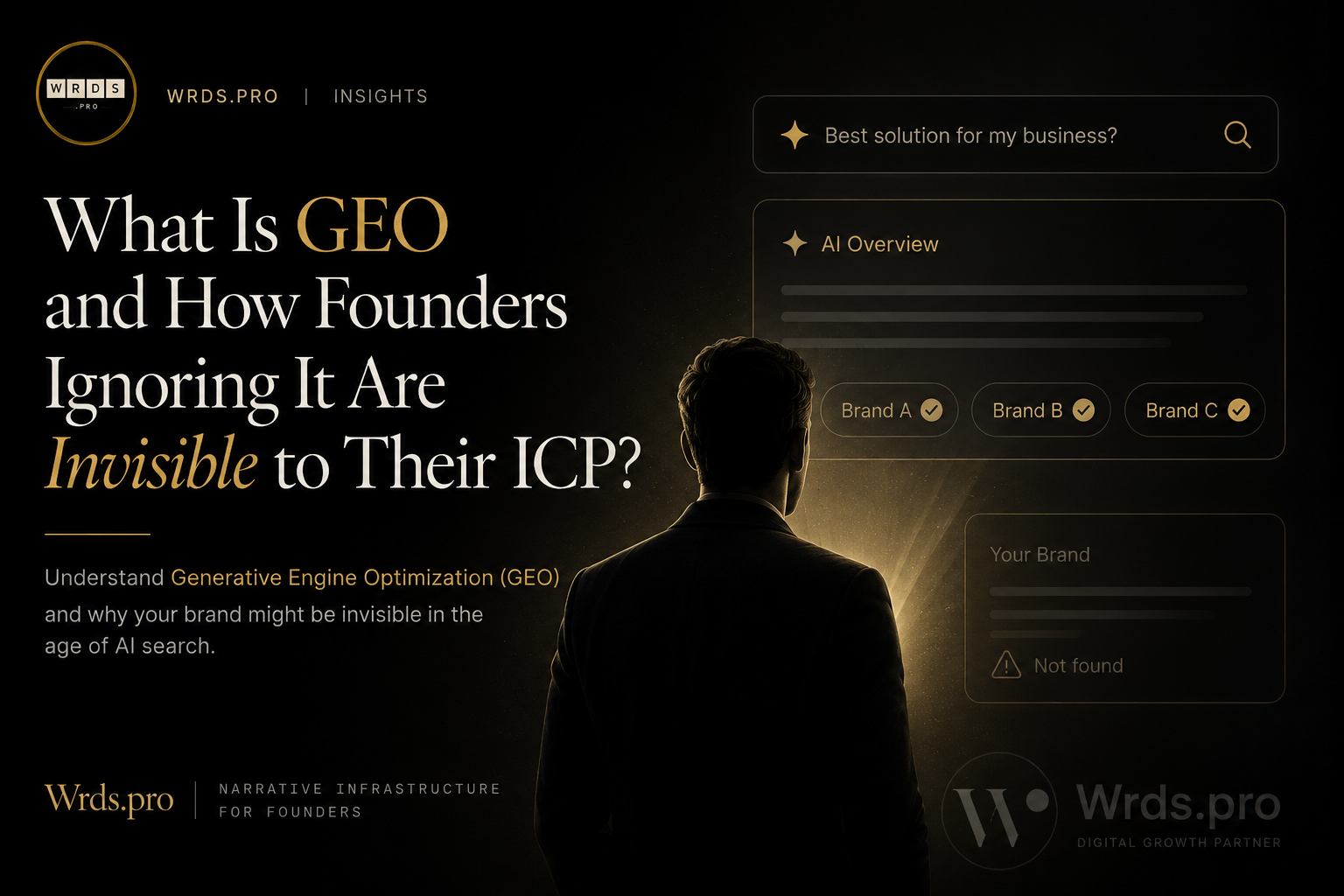 Your investor opens ChatGPT. Types: "Who are the most credible founders working on supply chain intelligence in North America?"
An answer appears. Three names. A paragraph on each. Sources cited.
Your name is not there.
This is not a hypothetical. It is a description of how a growing share of B2B research now happens, and why founders who have optimised exclusively for Google are discovering a second visibility problem they did not know they had.
GEO, Generative Engine Optimisation, is the discipline that determines whether you appear in that answer. This article explains what it is, why it matters more than most founders realise, and what the content infrastructure looks like that makes AI systems cite you rather than overlook you.
What GEO Actually Is
Generative Engine Optimisation is the practice of structuring content so that AI-powered search systems, ChatGPT Search, Perplexity, Google's AI Overviews, Gemini, Claude, retrieve and cite it when generating answers to relevant queries.
Traditional SEO optimises for an algorithm that ranks pages. GEO optimises for a retrieval system that selects sources. The distinction matters because the two systems reward different things.
A page can rank well on Google and never appear in an AI-generated answer. A piece of content with modest traditional SEO performance can become a frequently cited source inside AI responses if it is structured with the right signals. The overlap between what SEO rewards and what GEO rewards is real, but it is not complete.
The core difference between SEO and GEO:
- SEO — optimises for ranking position in a list of links. Success is measured by clicks and traffic.
- GEO — optimises for citation inside a generated answer. Success is measured by whether your content, your frameworks, and your name appear in the AI's response.
Both matter. But in 2025, only one of them is being systematically built by the founders who are gaining ground in AI-mediated discovery.
Why This Is Specifically a Founder Problem
GEO matters for every business with an online presence. But it is a particularly acute problem for founders, for reasons that are structural rather than incidental.
Your ICP has changed how they research
The buyers, investors, and senior hires that founders need to reach are disproportionately early adopters of AI tools. The decision-makers at Series A funds, the heads of procurement at enterprise companies, the VP-level candidates weighing their next move, these are the people who replaced Google with Perplexity eighteen months ago. They are now using AI tools as their primary research layer for vendor evaluation, founder credibility assessment, and category mapping.
When they ask an AI tool who the credible voices are in your space, they get an answer. If you are not in that answer, you do not exist in their initial research. And initial research is where shortlists are built.
The shortlist problem
Research from Forrester and B2B Institute consistently shows that the majority of B2B purchases end with a vendor who was on the buyer's day-one shortlist, built from names already in their head before formal research began. AI tools are now a primary mechanism for building that shortlist.
Founders who are not cited by AI systems are not being considered and then rejected. They are not being considered at all. The visibility gap precedes the credibility conversation.
Google alone is no longer enough
Even founders who have invested in SEO and rank well for relevant terms face a new reality: their Google presence does not automatically translate into AI citation surface. AI retrieval systems pull from indexed web content, but the selection criteria, fact density, semantic structure, named frameworks, recency, entity recognition, are different from the signals that determine Google rank position.
A founder can have strong Google visibility and near-zero GEO presence. Building both requires deliberate, parallel effort.
How AI Systems Decide What to Cite
Understanding what GEO requires starts with understanding how AI retrieval systems select their sources. The mechanism is not identical across ChatGPT, Perplexity, Google AI Overviews, and other tools, but the underlying signals they respond to are consistent enough to build a coherent strategy around.
The signals that determine AI citation:
- Fact density — AI systems retrieve content that makes specific, verifiable claims. Vague observations, general summaries, and motivational framing score poorly against content that contains named data points, defined concepts, and concrete assertions.
- Semantic clarity — content structured so that individual paragraphs can be extracted and paraphrased accurately. Convoluted prose, embedded qualifications, and dense academic language reduce retrievability.
- Named frameworks and original concepts — content that introduces proprietary terminology, named models, or original frameworks is treated as a primary source. AI systems cite originators, not aggregators.
- Entity recognition — the AI's ability to associate content with a specific, consistently identified person or organisation. Founders who publish under a consistent name, on consistent platforms, with consistent positioning, build a stronger entity signal.
- Topical authority — a body of content that covers a specific domain in depth and from multiple angles. A single excellent article is less likely to be cited than a consistent body of work on a focused subject.
- Recency and update signals — AI systems, particularly those with web access, weight recently published or recently updated content more heavily for fast-moving topics.
The content that AI systems want to cite is original, expert, structured thinking from a credible entity. That description is identical to the content that builds founder authority.
What Invisible Actually Costs Founders
GEO invisibility is not an abstract problem. It has concrete commercial consequences that compound over time in ways that are difficult to reverse once the disadvantage is established.
The investor meeting that never happened
A fund partner researching founders in your category uses Perplexity to build an initial list. Three names appear with substantive context, their frameworks, their track records, their contrarian positions on the market. Your name is not there. You are not on the initial list. You do not get the cold outreach. The introductions go to the founders AI already knows.
The enterprise buyer who chose the noisier founder
A head of procurement at a target account asks their AI tool: "Who are the credible vendors in [your category] that other enterprise teams trust?" Your competitor's founder is cited. Yours is not. The shortlist forms before a single sales conversation begins. Your outbound reaches a prospect who has already formed a preference, invisibly, through AI-mediated research.
The senior hire who went elsewhere
A VP-level candidate considering their next move researches founding teams in your space. They are not just evaluating the company. They are evaluating whether the founder is someone worth betting a career move on. They ask an AI tool. They get an answer. If your intellectual presence is not in that answer, your frameworks, your positions, your published thinking, you are not in their consideration set before the first conversation.
The category that belongs to someone else
Category leadership in AI-mediated discovery is not determined by who got there first. It is determined by who published the most credible, most structured, most consistently maintained body of work on the topic. The founder who has been systematically building GEO presence for twelve months is orders of magnitude harder to displace than one who starts when they finally feel the urgency.
What a GEO-Ready Content Infrastructure Looks Like for Founders
Building GEO presence is not a single action. It is an infrastructure, a body of content with the right structural properties, published consistently enough to establish topical authority and entity recognition across the AI systems your ICP uses.
1. Named Frameworks and Proprietary Concepts
AI systems cite originators. If you have a named model, a proprietary framework, or original terminology that you use consistently across your content, those concepts become anchors that AI retrieval systems associate with your entity. They also become impossible for competitors to replicate, because they are genuinely yours.
This does not require academic novelty. It requires making explicit the frameworks you already use implicitly, giving them names, defining them clearly, and referencing them consistently across your published work.
2. Fact-Dense, Specifically Structured Content
Every piece of content in a GEO-ready infrastructure makes specific claims. Not "many founders find that..." but a precisely cited figure with context. Not "thought leadership matters" but a precisely argued case for why a specific kind of thought leadership produces a specific kind of outcome.
The structural requirements are equally specific:
- Clear H2 and H3 headers that allow sections to be read independently
- Short paragraphs, three to four sentences maximum, that can be extracted without losing meaning
- Direct answers to specific questions, not introductions to future answers
- Definitions of key terms and concepts stated explicitly, not assumed
3. Consistent Entity Signals
AI systems build entity recognition from consistency. A founder who publishes under the same name, on the same platforms, with the same clearly defined positioning and topical focus, builds a stronger entity signal than one whose online presence is fragmented across different names, handles, and subject areas.
For founders, this means:
- A consistent LinkedIn presence with a clearly defined area of expertise
- Blog content published on a consistent domain with consistent authorship attribution
- Consistent use of proprietary terminology and named frameworks across all published content
- Regular publication cadence, recency signals are part of entity strength
4. Topical Depth, Not Topical Breadth
GEO rewards depth on a specific subject over breadth across many subjects. A founder who has published fifteen pieces on a precisely defined problem, each approaching it from a different angle, each adding a new layer of specificity, will build stronger AI citation surface in that domain than a founder who has published fifty pieces across a wide range of loosely related topics.
This is counterintuitive for founders who have been told that more content is better. In GEO, relevant depth is better. The goal is to become the entity that AI systems reach for when answering questions in your specific domain.
Frequently Asked Questions
What is GEO (Generative Engine Optimisation) for founders?
GEO, or Generative Engine Optimisation, is the practice of structuring content so that AI-powered search tools, including ChatGPT Search, Perplexity, Google AI Overviews, and Gemini, retrieve and cite it when generating answers to relevant queries. For founders, GEO determines whether your name, your frameworks, and your thinking appear when your investors, buyers, or potential hires ask an AI tool who the credible voices are in your category.
How is GEO different from SEO for startup founders?
SEO optimises your content for ranking position in Google's traditional search results, a list of links ordered by relevance and authority. GEO optimises your content to be selected as a cited source inside AI-generated answers. A founder can rank well on Google for relevant terms and still be absent from AI-generated responses about their category. Building both requires deliberate, parallel effort, though the underlying content qualities they reward, expertise, structure, fact density, and authority, are largely aligned.
Why does GEO matter for reaching my ICP as a founder?
Your ICP, investors, enterprise buyers, and senior hires, are disproportionately early adopters of AI research tools. Research consistently shows that B2B buyers build shortlists before formal vendor evaluation begins, and AI tools are now a primary mechanism for that initial shortlisting. Founders who are not cited by AI systems are not considered and rejected, they are not considered at all. GEO presence determines whether you exist in your ICP's initial research, before any conversation begins.
What kind of content gets cited by AI search engines?
AI retrieval systems consistently favour content with high fact density, specific, verifiable claims rather than general observations. Structural clarity matters: short paragraphs, clear headers, and direct answers to specific questions make content easier to extract and paraphrase. Named frameworks and original concepts signal primary-source status. Consistent entity recognition, content published under a consistent name, on consistent platforms, with consistent positioning, strengthens the likelihood of citation across multiple AI tools.
How long does it take to build GEO visibility as a founder?
Meaningful GEO citation signals typically begin to emerge within 60 to 90 days of consistent, well-structured content publication, provided the content meets the structural and quality criteria that AI retrieval systems respond to. Full topical authority, where AI systems consistently reach for your content when answering questions in your domain, builds over six to twelve months. The founders with the most durable GEO presence started building before they felt the urgency. The compounding nature of authority means early investment produces disproportionate returns.
Conclusion
The research process your ICP uses has changed. The shortlist they are building, of founders worth meeting, companies worth evaluating, teams worth joining, is now being assembled in AI tools, not just in Google. And the founders who appear in that research are not necessarily the ones with the best products or the longest track records. They are the ones whose thinking is structured, published, and consistent enough for AI systems to find, retrieve, and cite.
GEO is not a replacement for SEO. It is not a replacement for relationships, for product quality, or for the hard work of building something worth talking about. It is the infrastructure that ensures the thinking you have already done is discoverable by the people who need to hear it, before the first conversation, before the first meeting, before the first decision.
The founders who build that infrastructure now will compound its value for years. The ones who wait until they feel the invisibility will find it significantly harder to close the gap.
wrds.pro builds narrative infrastructure for startup founders, human-written, research-driven content optimised for both SEO and GEO, so your thinking appears everywhere your ICP looks. Visit wrds.pro to book a free Authority Audit.